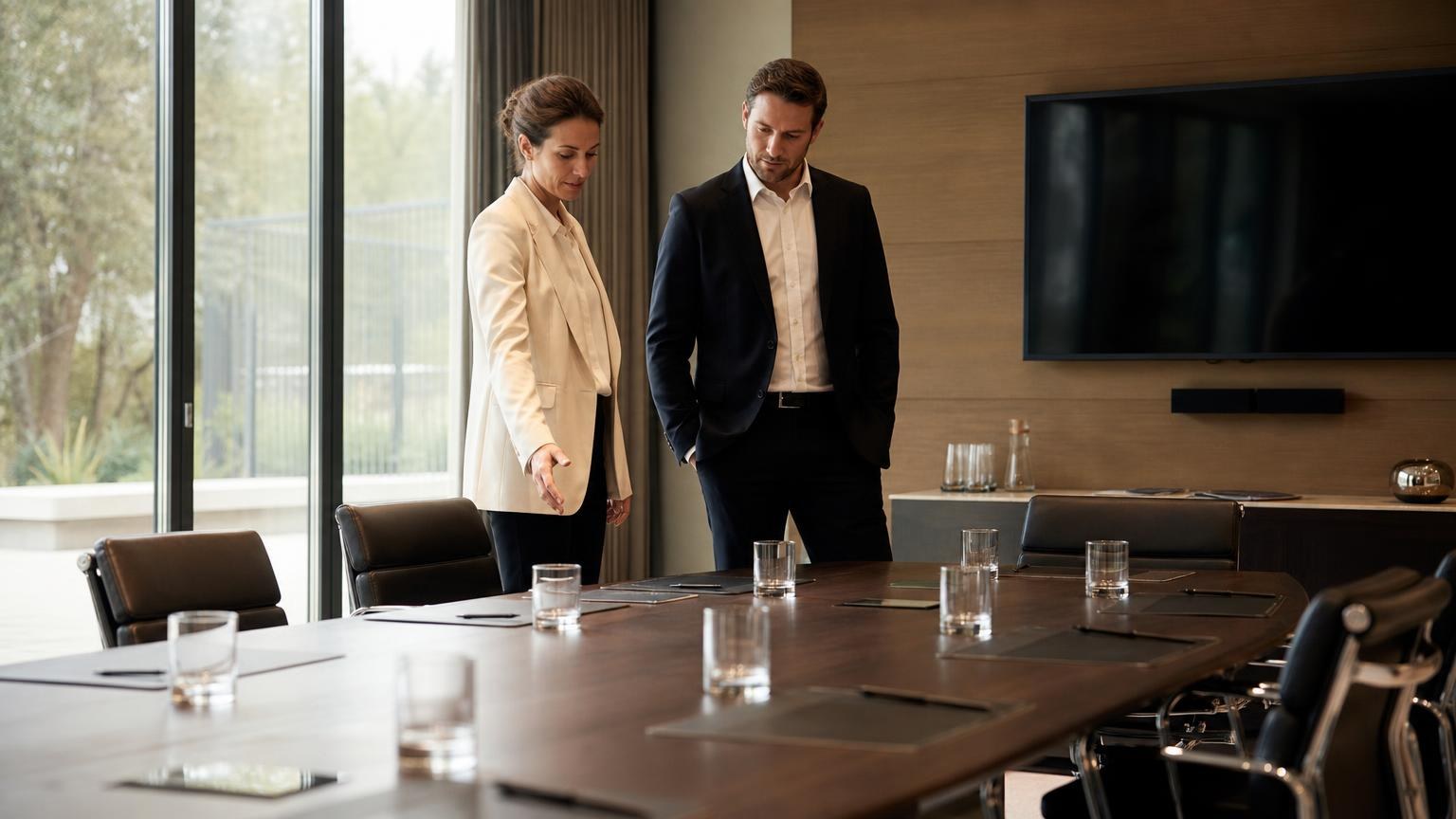


The Work-life Insight

If you or your team is struggling to win deals, navigate a tricky business situation, or communicate effectively, it may be worth your while to enlist expert guidance. A negotiation consultant can help you hone your strategy and guide you through a challenging situation with greater ease, confidence, and dexterity. But how do you know which consultant is best suited to your needs? We’ve outlined five things to keep in mind when choosing a negotiation consultant partner.

1. Identify what problem you’re trying to solve
Before you seek out help, it’s important to identify what you’re struggling with. In other words, what’s the primary problem you’re looking to solve? If you manage a sales team, figure out what part of the sales process is causing the biggest roadblock to success. Is your team having trouble showing value? Setting expectations? Implementing the deals it’s created? If you can pinpoint the root of your problem, you’ll have a better idea of what type of help you need to solve it.
2. Figure out what approach you’re looking for
When it comes to learning negotiation skills, there are three basic teaching approaches: academic, theoretical, and practical. Some consultants will offer an academic approach that focuses on things such as negotiation terms, acronyms, and rigid, linear processes. Although this background information can provide a loose guideline, a purely academic approach doesn’t address how to apply those skills in practice. In other words, you can learn all about game theory—what it is, how it works, what’s involved—but that doesn’t mean you’ll be equipped to deal with real emotions being exhibited by people in contentious life situations.
In order for negotiation coaching to be effective, it needs to address how theories and rules will be translated into practical skills—and how those practical skills will be reinforced to become second nature. This advanced learning is possible only when you incorporate all three approaches. Of course, a three-part approach takes more time, but it also ensures that changes will stick long after the course is over.
Any decent negotiation training seminar is going to give your team a confidence boost. But how long will that feeling last? You may hope that confidence pulls them through the next big challenge, but hope isn’t a viable strategy. Instead, seek out a negotiation consultant who will create a plan for reinforcement and execution.
3. Consider your timeline
It’s easy to memorize information for a short period of time—that’s why cramming the night before a big test can sometimes pay off. However, once that test is over, almost none of what you studied is bound to stick (which is why most of us have trouble recalling world history facts we learned in school). When all is said and done, memorizing information isn’t the same as truly learning it. And there’s no shortcut or workaround to learning—it takes time, repetition, real-world/low stakes practice, and reinforcement.
You’re not going to change how everyone on your team communicates in one eight-hour session. Instead, look for a consultant who is willing to spread things out in order to help you get your money’s worth.
To truly change how you or your team thinks, communicates, and operates in high-stakes negotiations, you need plenty of low-stakes practice under your belt. We recommend a coaching timeline of 12 weeks, in which you can learn new skills, practice those skills in real-world situations, and reconvene after each trial to debrief. This combination of academic, theoretical, and practical learning will help ensure that small successes become long-term trends.
4. Create a plan to ensure long-term success
It’s important to find a partner who’s committed to your success even after you’ve parted ways. In addition to teaching you negotiation skills, coaching you through challenging situations, and giving you opportunities to practice, the right coach will provide a framework for continued growth.
At the Black Swan Group, one of our greatest strengths lies in our ability to simplify communication. When your mind is going a mile a minute, it’s hard to let things go and even harder to focus on the basics. By teaching the foundations of effective communication, we aim to give our clients a more agile framework. Our approach isn’t about following a standard process or technical formula—it’s about using the skills in your toolbox to adapt in the moment. To do that, you need to understand how people approach conflict and know how to communicate in a way that will resonate with the individual.
5. Trust your gut
Effective negotiators know how to make their counterpart feel positive, collaborative, and at ease. If you’re talking to a consultant company and you feel like you’re being given a sales pitch, it’s a clear sign that they’re not good at what they do. As you choose between different options, think of every conversation in your decision-making process as a tryout. Do you feel like they understand your challenges and concerns, or are they giving you canned responses? The best negotiation consultants will know how to practice what they preach.

"Coworking has boomed in the past five years and has grown in popularity, not only among independent workers and startups but also with corporate users as well. As coworking becomes a norm, we expect to see many additives and changes to the co-working space in 2019.
Let’s take a look at a few of the trends we expect to see for coworking in 2019.
Coworking Will Continue to Have an Impact on Commercial Real Estate
Coworking has a major impact on how the commercial real estate industry performs. Coworking operators have delivered a large amount of positive net absorption in major metropolitan markets. Coworking has also encouraged traditional landlords to provide upgrades and increased amenities. Landlords have been investing heavily not only into the structure of the building but also in their communal spaces.
Coworking Spaces Will Expand
Years ago, coworking spaces typically did not exceed 20,000 square feet. In today’s market, it is not rare to see coworking spaces lease over 100,000 square feet, targeting corporations and long-standing businesses. Many large enterprise users like Verizon, Toyota and IBM have realized the benefits of coworking space, proving that outsourced, temporary leasing structures are appealing to companies of all sizes, from corporate users to startups and entrepreneurs.
Increased Focus on Niches
Coworking operators are focusing on niches and finding exponential growth and higher profit margins. By focusing on specific niches, coworking facilities are able to create a community of people that support each other and develop a shared economy. This type of specialization can deliver more access to expertise, industry-specific knowledge and a community of people with similar interests.
Big Corporations are Utilizing Coworking Spaces
Large corporate companies like KPMG, Microsoft, and Toyota are starting to test out using coworking. Some are even looking at funding new co-working ventures. For certain big corporations, entire teams are shifting into coworking offices allowing them better access to education, innovation, and talent with lower initial real estate costs and greater flexibility. According to Recode, companies with more than 1,000 employees now make up 25 percent of WeWork’s annual revenue and WeWork reported that this number increased by 250% in 2017.
Coworking has a Global Reach
Coworking spaces are located in almost every major market in the world. The largest coworking company, IWG, was founded in Belgium but now has a large footprint in the United States. Many other coworking operators have entered markets across the globe, turning this trend into a norm for countries around the world.
Why Coworking Will Remain Popular
As work styles change and new generations enter the workforce, coworking will remain a viable option. Millennials want to work how they want and when they want, which is something coworking spaces can offer. With technology allowing professionals to be more mobile than ever, a traditional office space does not offer the right environment for certain professionals and businesses to be the most productive and efficient. Landlords have even started to partner with coworking operators to include entire floors to attract and retain new tenants.
Credit: http://hsprealestategroup.com
Posted on December 24, 2018
1. Data Blending
Most companies have a lot of data—volumes of it, in fact.
It’s not stored neatly and it’s not all in the same place. If your company is like most, your data is housed on several servers, maybe thousands of miles apart, and comes in a number of different formats, i.e. Microsoft Excel, XML, SAS, .tab, .shp. Some of it may be unstructured data, such as your Twitter feeds, Facebook likes, Google Analytics, and online surveys.
If tasked with bringing all this data together for analytical purposes, you may be wondering exactly how to pull this off.
Here’s the thing: Excel and Access are in over their heads with the level of data. Your IT department can write code, but there is an easier solution that offers a fast and simple way to blend data: Alteryx.
Alteryx was built for data. It’s that simple. It allows the data analyst direct access to the data regardless of its type or source. Alteryx brings data of any type or any level together. This means that it can be joined at both the record and field level. It can even be expanded to include multiple key fields. Alteryx is flexible enough to join data on non-identical fields, as well as incorporate spatial characteristics such as customer points to be combined into your data. Other tools like Fuzzy Matching give users the ability to match two datasets based on non-matching data—typically names and addresses.

ORGANIZATIONAL CULTURE: Why It Matters
Taking agile to scale is major departure from the traditional command-and-control style — and it’s becoming increasingly popular. But you can’t do this halfway. Here’s what to know before you dive in.
With talk of scrums and sprinting, corporate environments are starting to sound a bit more like rugby matches these days. But the terminology, borrowed from the popular English sport, actually refers to an alternative way of managing work: agile.
Kristine Dery, a research scientist with the MIT Center for Information Systems Research who is studying agile at scale, also known as agile management or scaled agile, as it relates to the employee experience, said making the switch represents a major overhaul for any organization.
But, by many measures, it appears to be a more effective way of working in a rapidly-evolving digital environment. Large companies like Spotify, Ericsson, Microsoft, and Riot Games have all adopted the method.
So what is agile, and is it the right fit for your firm? And what should you do to prepare for implementing it?
What is agile?
Agile, first introduced in 2001 in the Manifesto for Agile Software Development, started out as a method used in software development that challenged the traditional, linear “waterfall” development model, in which entire projects are pre-planned, then fully built out before they are tested. Agile’s approach offers iterative flexibility, with small parts of projects being built and tested simultaneously.
Taking a more iterative approach makes it easier to keep projects aligned, on track and relevant, and it allows for the release of “minimum viable products” to gather more frequent user feedback from clients earlier in the process. That helps guide the team on what needs to be changed or altered to make the product more successful.
“The traditional method of managing, the waterfall method, which is very inflexible, planned-in-advance, linear, and not iterative at all, wasn’t lending itself at all to the flexibility and the adjustments that were necessary to make great software,” said Carine Simon, a senior lecturer and industry liaison at MIT Sloan, who helped lead a transition to agile at scale at Liberty Mutual Insurance. “[Agile is] iterating with customer feedback, prototypes, and tests, versus taking some requirements and issuing the product maybe a year later, when the customer’s requirements have changed or technology has evolved.”
The idea is to allow the end user to have a clearer view of their requirements for the finished product earlier in the process of creating it, instead of receiving a final product that may not end up looking exactly like what they had anticipated.
“It’s a series of experiments, as opposed to one linear project where you get to the end and find out if it works,” Dery said. “On lots of projects with long timeframes, once you get to the end, the problem has shifted and often you’ll be coming up with a solution that is now removed from the problem.”
What is agile at scale?
Seeing agile’s success in information technology and the growing prevalence of technology throughout business at large, many companies began to ask whether the method’s practices and philosophies could be scaled up to apply with equal success to other projects or even entire business functions, Simon and Dery said.
“[Companies] said ‘Let’s see if we could move projects forward, not necessarily faster, but to get better results out of some of the projects we have, given that just about every project involves technology to some extent. Maybe it’s an opportunity to work differently,’” Dery said.
Simon said companies that adopt agile at scale benefit from breaking down functional silos and pooling the talent from each function into teams. “In the traditional management, you have one leader for each function … but the coordination and collaboration between those functions is often difficult, whereas if you create one team that pools members from each, then the thinking is that the project will be more successful. All projects are going through a similar mode of management.”
During her time at Liberty Mutual, Simon said teams developing customer-facing products began adopting agile methods at scale to redesign the process for onboarding new customers. That required pulling together the various teams involved in parts of the process to bring their perspectives together: the marketing team who designed onboarding collaterals, the call center team whose agents are on the phones with the customers, the finance team who is dealing with the different payment methods.
“It brought a team together with all those perspectives, making them collaboratively work on redesigning the process iteratively to come up with minimum viable products,” Simon said.
The switch, she said, saw the team members empowered to own the product from beginning to end and led to better products.
But adopting agile at scale means more than just plugging a new tool into an existing framework. It requires a paradigm shift at the organizational level, Dery said. “The biggest downfall is not understanding what a vast departure it is, and not investing in the learning and support that’s required to build the environment that enables it to work effectively.”
Learn a new language
Dery said those who plan on applying agile to their organization will need to learn to work within an entirely new methodology that has its own lexicon of terms to describe its workflow.
During the process, known as a “Scrum,” work is assigned to cross-functional teams and divided into “sprints” — the basic unit of progress delineated by a specific timeframe, usually two weeks to a month.
Then, there are “scrum masters” who coordinate the team’s activities, and each day members meet for short “stand-up” or “daily scrum” meetings to provide updates on the prior day’s work, the work planned ahead, and any potential stumbling blocks.
“It’s a way of coming together to make sure those things are addressed. They keep the project moving forward,” Dery said of the stand-ups. Indeed, agile sprints were so-named to evoke a sense of pace.
Development is a trail-and-error, test-and-learn process, Dery said, and the product is rolled out in small pieces at the end of each sprint. Features that still need to be completed are added to a “product backlog,” with the most crucial taking highest priority.
Within a Scrum, team members are typically afforded more autonomy in how they approach tasks and resolve problems in a departure from a command-and-control structure of project management. The concept is that those closest to the work know best how to address issues.
“You’re working on the problem all the time, as opposed to working on the solution,” Dery said. “It’s a different way of thinking and organizing, and it requires a different set of disciplines. You’re constantly assessing where you’re at, what you’re doing, and what you want to deliver.”

Ready for this? Go in fully committed.
Dery said companies that decide to deploy agile at an organizational scale often find that the difficulty in doing so is much greater than what they had anticipated, especially when it comes to the impact such a shift can have on employees.
“There’s no just ‘dipping your toes in the water,’” she said. “The experiment is going in fully committed to see how this allows you to work differently and build value.”
A traditional, static office design isn’t necessarily the best fit for an agile work environment, she said. They’re much better suited to a more flexible space, with movable furniture and design thinking walls. “You want it visual, for working out loud, to work it out where they are at,” she said.
Since the method requires significant close teamwork, organizations will need to ensure there are adequate video and telecommuting technologies in place for times when all team members can’t be in the same location.
Providing coaching for employees to change their work habits to better align with the agile management style is also crucial to success. “You need to be supporting not just their capabilities, but also helping build the type of work habits more suited to this way of working,” Dery said.
Scrum masters are usually responsible for ensuring that happens, and for attracting the right kind of talent to provide it.
Watch out for these friction points
Agile and waterfall methodologies are so different that they often end up butting heads when a project moves from one to the other, Dery said.
“They’re such very different ways of working,” she said. “If you’ve done one part in agile and then you throw it into waterfall, it’s a very, very different approach. It causes a lot of things to stall or get lost as [the project] is translated from one to the other.”
Dery said it’s still unclear what the best approach may be to head off such areas of friction as companies roll out agile to greater extents.
Simon said giving up the sort of control that agile requires can be threatening to some managers, and any company weighing a shift to the style should identify the functions or departments that lend themselves to it and implement them there first. If it’s successful, the track record of wins can help sway other functions to give it a shot.
Some functions whose processes are very certain and repeatable or governed by outside regulatory or compliance requirements may never need agile management, nor would they necessarily benefit from it, she noted. Even if agile looks great on paper, it won’t work if there’s too much resistance.
“In customer-centric processes where customer input is key, and in that sense it’s quite uncertain or fast-changing, then those would be the types of areas in a firm that lend themselves to agile,” she said. “You need some early wins, picking the top areas of your firm to try agile and get familiar with it, so that managers can get on board.”

Benefits of Renting a Training RoomIt has become very common for small businesses and entrepreneurs to rent an office or a work space for rent, but now many are also beginning to use training rentals. A training space for rent has become the latest trend now that more companies and businesses are realizing the importance of proper training for their employees.
Major Issues with Poor Training-Room Facilities
Training is an essential part of any company that has employees because it ensures that every worker has the skills and knowledge to do an exceptional job. However, many companies do not have their own fully functional training space and are forced to do their training using inadequate environments. Unfortunately, a poor training room can negate many of the benefits of training.Some of the biggest issues with poor training spaces include:
Lack of Necessary Technology
If a training room is not equipped with the right technology (such as video-conferencing systems, projectors, or multimedia displays), you may not be able to give your employees the information they need or train them to the level required.
Poor Conditions
Cramped spaces, excessive noise, and poorly furnished rooms (such as ones without desks, tables, or chairs) can end up being very distracting, thus causing your employees to lose out on much of the learning.
Bad Impression
Poor training rooms can make a bad impression on participants. This is particularly harmful when participants are clients, colleagues, or partners, as opposed to employees. An unprofessional space can quickly sour the experience and cause clients or employees to look elsewhere.
Benefits of a Training Room
With training rooms for rent in Jersey city there is no reason for any company—big or small—to use inadequate spaces. Training rooms for rent have a number of benefits.
Affordable
Commercial spaces are prohibitively expensive to buy. Not only are they pricey, but the costs of purchasing the right technology, furnishings, and equipment for the training space are very high. On the other hand, a training space for rent is a fraction of the cost, offering access to professional training rooms at affordable rates.
Right Infrastructure
Training rooms for rent come with the technology that you need—including projectors, video-conferencing systems, and whiteboards—for effective training and presentations.
Designed for Training
When you rent a training room, you can be assured that you are getting a fully functional space that meets your needs. Training rooms can be rented in large sizes to accommodate many participants, or in reduced sizes for smaller meetings. Furnishings, lighting, and design all adhere to professional standards.
Professional
If you want to make a good impression on clients, you need to use a professional space. Training and seminar rooms are professional environments that will help your small business or startup present a more professional image.
Secondary Services and Amenities
The best training rooms for rent will offer secondary services and amenities, including live receptionist services, administrative help, and access to other areas, such as kitchens or lounges. Look for office space rental companies that can offer you the services you need to conduct the best training possible.
WorkSocial offers mailbox services and virtual offices along with fully-furnished executive office suites and training rooms for rent in Jersey City, NJL
earn how to Designing Effective Meeting Rooms


The Room is Killing Your Meeting – Here’s How You Can fix it
We spend a huge amount of our workday in meetings. Middle managers are estimated to spend about 35% of their workday in meetings. Executives can spend as much as half their day in meetings. That’s a lot of time!
A lot of wisdom has been shared about designing and running effective meetings. Yet few resources offer advice on the meeting room itself. The meeting room is a core piece of the meeting experience. Effective meeting room design can impact and change your entire meeting.
Well-designed meeting rooms can put attendees at ease, encourage conversation, and induce creativity. Mindful meeting room design can drastically improve effectiveness of your meetings.
Tips to Design Effective Meeting Rooms:
The Purpose of the Room
The key to designing meeting rooms is to understand your team’s needs. Firstly, decide on size and location of the room. Some key questions to answer here are:
- What will the room be used for? Are these going to be smaller, collaborative rooms or do you need a full size boardroom?
- How does your team like to work? Do they work in small groups or do they work in large teams?
- Is this room meant to be client facing, or is it for internal use only?
- Does this room need to be within easy access from employees, or does it need to be located further away for additional privacy?
Taking a step back to look at use cases allows you to begin tailoring your meeting rooms to the way that your organization works.
In addition to understanding how employees prefer to collaborate, it’s also important to understand where they like to collaborate. Meeting room analytics such as average meeting size and room utilization rates will help you determine the size and number of rooms you need.
Once you decide on placement and size, you can use your understanding of the purpose of the room to further enhance its design.
Equipping the Room
Essential equipment should be evaluated before moving onto more creative aspects of meeting space design. Fleshing out these essentials, based on user needs, will help provide a base for your creative choices.
Here are some considerations to keep in mind when building out your equipment requirements.
Furniture
It’s important to understand how the room will be used and identify key requirements. For example, will people need to move the chairs around and swivel to look at a screen? If so, a requirement might be chairs on casters that can swivel. Alternatively, if the room is meant for creative work, you might want to provide alternative seating that encourages more freedom.
As for tables and surfaces, consider not just size, but usage. Would people be primarily standing or sitting in their meetings? If they use the room for standing meetings, you might require a standing or height-adjustable table. Do the tables need to be moved?
Additionally, think about power and power access. Do you need power access through the table for other equipment? What about charging outlets for attendees with mobile devices – this could include USB charging ports or wireless charging.
Beyond choosing the right table and chairs for the meeting room, there are some other furniture considerations. For example, do you need in-room storage for meeting supplies? Do you need whiteboards?
Check out the Google Ventures design war room in the video below and see how the purpose of the room changed the design and furniture requirements.
Technology
As our world becomes increasingly digital and mobile, audiovisual equipment is now key to the meeting experience. Some core pieces to include in your technology selection include screens/displays and communication devices.
Again, consider how that technology will be used in each room. Not every room requires a screen or a communications device, and rooms should be appropriately outfitted based on their purpose. Some rooms might benefit from a traditional whiteboard and marker, while others might require advanced teleconferencing tools such as high quality cameras and microphones. Most rooms might simply need an easy to use AV presentation system.
Meeting rooms are typically high demand spaces in the office. Poor planning regarding booking processes can lead to unnecessary tension and conflict in the workplace. Beyond displays and communication, an important aspect to consider is how meeting rooms are booked and used.
Tools such as digital displays installed outside the meeting rooms and sensors to detect room occupancy can help alleviate some of these conflicts in the workplace and improve productivity.
Lighting
Lighting is crucial to the meeting room experience. Excessively soft lighting might result in participants dozing off. On the other hand, harsh lighting might not be conducive for reading and viewing of screens.
Once again, understanding the purpose of the room is crucial in building lighting requirements. For rooms that are designed to be comfortable, cozy spaces, softer lighting is often necessary. Large boardrooms might require more brightness, and rooms with projectors might require dimming lights.
Lighting is also heavily dependent on the location of the room. If the room has a lot of natural light, you might have to look at reducing lighting with blinds. For rooms without windows, light must be a primary consideration in room design.
Sound
Sound management is often one of the most neglected pieces in meeting room design. Meeting rooms that are designed without consideration for sound often result in unwanted side effects.
This could include echoing and reverberation, scraping from moving furniture, or feedback between microphones and speakers.
Acoustic controls are now available in a variety of designs that add to the feel of a meeting room, rather than take away from it. Wall mounted acoustical panels are effective at keeping sound in, as are ceiling mounted baffles. If it’s sound from outside the meeting you want to keep out, look at using similar solutions throughout your office to reduce sound reverberation.
Fleshing out the rest of the meeting room experience
Once you’ve finished designing and implementing the physical environment of the meeting room, the next step is to consider and design the full meeting experience. You will want to think about how people use the room, from start to finish.
Firstly, how do people reserve and book the meeting rooms? Are only specific teams allowed to use specific rooms? Do you require a dedicated staff member to manage these rooms and requests? We recommend using a meeting room booking system such as Workscape to make booking rooms simple for your team. This will help you avoid scheduling conflicts and ensure smooth processes in using the room.
Second, how do people use amenities that are in the room? Are your audiovisual tools easy to start and use, or do you need a technical team member available to set up these meeting rooms beforehand?
Some other ideas to consider:
- Would you stock refreshments in each room?
- If the room requires additional privacy but has glass walls, would you need to add privacy blinds?
Finally, how would you know when the meeting ends and the room is available? Do you need a team member to clean up the room after each use? What if a meeting ends early? Would you be able to use that additional time for other meetings? Workscape can help with this by using smart sensors. It is simple – just plug the sensors in and Workscape will inform you when a meeting ends early, or if not one shows up for a meeting.
Get Creative!
Once you firm up the hard requirements for your meeting rooms, you can get creative in your meeting room designs.
The key here is to enhance your corporate culture and identity with your meeting room experience. Keeping your equipment requirements and room goals in mind, choose furniture, paint, and decorations that match your corporate culture and the image you want to convey.
Struggling to get creative? Here are some ideas on how you can inject your company culture into your meeting room design:
Color scheme
Color can change the experience of a room. Using official company colors is a classic way to match the meeting rooms and echo the company brand experience.
For more formal boardrooms and conference rooms, neutral colors are always a good choice. Despite being formal, you can spice up the room with a kick of color. For example, Resignation Media’s office in Texas maintains formality in their meeting rooms with neutral gray, white and black. To add a bit of personality to the room, the firm opted to go with with multi-colored chairs.

Unconventional color choices can be used to express company culture and influence meetings as well. Strong colors such as red and orange can evoke excitement and even aggression, and might be suited to encourage teams working towards competitive targets.
Other colors such as green and blue can be calming and refreshing, and help alleviate some of the tension in charged meetings. Yandex’s meeting room in Kazan uses yellow-green to create a refreshing, soothing space for relaxation and more casual conversations.

Materials
Similar to color, materials can change how a space is perceived. Glass and chrome can often push a modern, clean look. On the other hand, wood is extremely versatile and can be used in many applications. The right wood can bring warmth into the room and add some rustic charm. X3’s office in Romania converts an attic into a charming, cozy space with the use of wood beams and tables. Comfy chairs further add to the cozy warmness.

By blending colour and materials, you can shape how the space feels. True North Mortgage in Dallas uses glass and white to portray a clean, modern meeting room.

On the other hand, Rocket Fuel Chicago uses a similar design, but selected a fun lime green as their primary color. This creates excitement and energy, contrasting with True North Mortgage’s clean white.

Tie Your Space to Your Company
Tying the space to the company doesn’t necessarily mean emblazoning your logo everywhere. While that design element might work for some spaces, other spaces could call for subtler elements.
One way to creatively make the space your own is to tie the space to what you do. Red Cross Blood Processing Service in Melbourne achieves this by decorating the walls of their meeting rooms with blood type lettering. This gives a shout out to the mission and goals of the organization, and makes the meeting room truly a Red Cross meeting room.

While Adidas Shanghai prominently includes the Adidas logo in the conference room, the highlight is actually the 3 strips of white that evokes Adidas’s iconic brand. Combining that with the brand’s classic black and white combination really strongly ties the meeting room to the brand, making it a great space for client meetings.

Other rooms in the Adidas Shanghai office maintain the black and white motif, but depict images of athletes as well as value statements. The decorations are still strongly tied to the brand identity and very clearly mark the space as Adidas.

Don’t be afraid to have fun!
Meeting rooms and spaces do not have to be stoic spaces devoid of personality. Adding elements of fun can help transform a dry boring meeting into an engaging, exciting one. What’s important here is to keep in mind your workplace culture – embrace it and do not be afraid to include the more outlandish ideals.
Red Bull’s Mexico office embraces fun, transparent meetings with this meeting and lounge space. Not having any walls creates a space that’s open and inviting, as well as connected to the rest of the office. The playfulness fits with Red Bull’s unconventional brand.

Facebook is infamous for the miNY room in New York, popularized through Instagram by celebrity guests. A miniaturized room, it features tiny furniture and a parody of Facebook’s workplace culture. While more fun than functional, the room’s purpose is to make a statement and create a strong memory for guests.
Have Excellent Meetings
Meetings are a huge part of our working life. Effective planning can improve the content of a meeting, but it is extremely important to consider your meeting environment and processes. Having a well-designed meeting space, that has fully considered how meetings will run, will help to significantly enhance the meeting experience for you and your attendees.
Designing a meeting space and want to simplify meeting room booking? Workscape can help – sign up for a free consultation now.
Credit: https://www.workscape.io


How Do I Improve My SAT [or any] Score?
As always: study, study, study.
Get a handle on the underlying academic concepts tested on the SAT, and bone up on the areas where you’re deficient. Then, you might want to consider signing up for a prep course, like those offered by Prep Expert.
Prep Expert’s courses will teach you test-taking strategies – how to notice trap answers or read passages more effectively, for example – and can go a long way toward improving your score.

200 Points is No Joke
When it comes to particular schools, the average scores for admitted students will change from year to year, and the trend is almost always up – If a particularly large number of students apply to a school in a given year, the average SAT score of admitted students could go way up, making that school much tougher to get into. So when you make your list, it’s probably a good idea to have at least a few ‘target’ schools where you’re closer to the 60th-70th percentile of SAT scores.
3 Steps to Breakthrough
Develop a(1) Strategy (Develop a Strategy of Success)(2) Story (Visualize Success)(3) Be in a Peak State (Exercise & Practice)How to Develop a Strategy of Success: Click Here

With questions? Surprisingly…no!
Not with questions. At least, not with open-ended or questions that are meant to be answered with a “yes.”

Your best tools are statements based on observations. Labels and cold reads. They extend thought processes, helping people open up the flow of what they are thinking and causing them to say it out loud.
Is it crazy to think this would work for you and your unique situation?Here’s one label that Los Angeles area real estate broker Kendyl Young and her team are using in open-houses for residential real estate. They will use it after a twosome has walked through a house discussing it:
“It looks like you had a lot to talk about.”
Kendyl has described this approach as opening up the floodgates of truth talk.
Before they would ask a good calibrated (open-ended) question such as “What did you think?” or “How does this house work for you?” This would often be met with some information. But not a lot. Certainly no opening of floodgates.
When she and her team switched over to labels / cold reads such as the one above – they’ve started getting responses like: “Oh yeah!!!” and then a deluge of what the prospective buyer’s thoughts were.
The Black Swan Group is defining a “cold read” as an observation you can make of the situation before anything is said by your counterpart. It can be an observation of physical actions, body language, or predictable responses to the circumstances at hand.
It can be adding up the facts as known and stating a hypothesis, as opposed to asking if something is true.
A number of years ago, I was interviewing an informant with my partner in the FBI. The informant had far too much detail about the robbery of a video store to have not been a participant. He was telling us the story, claiming that it had been told to him by the target of our investigation (the robber).
When it occurred to me what the truth was I didn’t ask a question, I stated, “You know this much about the robbery because you participated in it.”
I didn’t say it as an “aha!”. I didn’t state it as an accusation or a “gotcha!”. I just said it quietly as a simple fact, with a downward intonation in my voice.
He hesitated for a moment and quietly said, “Yes.” I still remember the shocked look on my partner’s face as he stared at me.
I’d done this wrong in the past. I once participated in an interview of a drug dealer. We were looking for his brother. We showed him a picture of his brother, and I asked him if he knew who was in the picture.
He said “No.”
“This isn’t your brother?”
“No.”
“Who then, is it!?”
“I don’t know.”
Later, in the same interview, I got frustrated and simply said:
“I’m not asking you, I’m telling you, I know this is your brother.”
He said, “So?”
People react differently to statements than they react to questions.
Both the good thing and the bad thing about a good calibrated question is that it makes people stop and think. (Calibrated questions are primarily questions that begin with “What…?” or “How…?” – they are not questions where we are hoping for a confirmation of a “yes”.)
The process of getting them to stop and think will often have the opposite effect of “unlocking the floodgates” of truth telling by virtue of getting them to stop and think.
You can apply this idea to any situation where you want to encourage who you’re dealing with to simply open-up.
Brandon Voss does this all the time with people who call The Black Swan Group to inquire about training.
Prospective client: “So give me your sales pitch.”
Brandon: “It seems like you got a lot of problems you’re trying to solve.”
Prospective client: (Whoosh! 45 minutes of outlining challenges.)
Kendyl and her team even brainstorm cold-reads together. They talk about typical things they frequently see when buyers come through houses and then come up with cold-reads to use.
They use them and then report back to the rest of the team the results. Very smart!
After a while, no matter what your circumstances are, you can probably pretty much describe the 5 – 7 types of potential clients you see the most frequently. That’s what intuition and experience are all about – getting a good feel for your typical challenges.
Come up with some and try them! Find your own ways to unlock the floodgates and create great relationships.
Relationships = Revenue
Good luck!
Click here & Learn to negotiate like no one other

So you're tasked with planning a strategic offsite for your team. If you're new to planning or just need a refresh, you've come to right place. We know there are a ton of moving parts, so we built a guide that outlines everything you should consider when planning an offsite.From finding the right venue to choosing a crowd-pleasing menu, ensure everything goes according to plan with these tips below:
1. Lock down the date.
First things first, make sure the whole team can attend. After you've double checked that everyone is free, send out a calendar invite as a placeholder before anyone books a trip or schedules a meeting.
2. Budget wisely.
Budget will be the determining factor on whether you can splurge or need to save on the venue and catering. Expect to spend about 70% on the venue, 25% on food and beverages, and 5% on transportation and miscellaneous supplies. Fees at WorkSocial are less than any hotel in the area.
3. Finalize the agenda ahead of time.
Ask the team lead for the proposed agenda in advance. From there, you'll know how long to book the venue for, how long to set aside for meals, and can let the caterers know when to arrive and cleanup. This will help determine if you have time allocated for setup, breakdown, all agenda items, and some buffer time for breaks and potential delays.
4. Choose a venue that is both functional and inspiring.
Consider the primary purpose for the offsite — is it to spark new ideas, motivate the team, increase team unity? If the answer is yes, look for a venue that offers natural light and breakout areas. Bonus points if you find a spot with outdoor space and close to the waterfront in Jersey City.
Find the perfect venue for your offsite in the New Jersey and New York City metro area.
5. Order food that fuels.
Think outside the boxed lunch and bagel route and choose catering that will keep the team satisfied so energy levels don't drop midday. These sample catering menus are a great place to find inspiration.
6. Hydrate and caffeinate.
Even if you're not supplying breakfast, let the smell of fresh coffee welcome the team to kickstart the day. Supply the venue with enough water bottles and other beverages to keep everyone hydrated until happy hour. All included at WorkSocial's training room venue.
7. Designate someone to be your eyes and ears.
If you're not attending the offsite, make sure the point person knows the catering company's contact info, how to get inside the venue, and any other logistical details. Check in with them throughout the day to make sure everything is going according to plan.
8. Dot your I's and cross your T's.
The day before the offsite, get the finalized headcount and confirm all last minute details with the venue, catering company, and team leads to avoid any last minute surprises. Which will all be handled by WorkSocial's team!
9. Ask for feedback.
After the offsite, ask the team leader for feedback on the venue, catering, or if there was anything you could have done differently. Even if the offsite was a smashing success, there's always room for improvement!
Credit:
Oscar Peerspace
Website: https://www.peerspace.com/

Training rooms are much more than spaces where employees come to sit and learn – they’re dynamic environments where people meet, learn, share ideas and collaborate. When designing a space to accommodate such a wide range of activities, it can be hard to decide which aspect of the design should take priority.Our advice? Flexibility. Just like at WorkSocials premier training roomThe following considerations will help you create a flexible and effective training room space.
1. Get Physical
The best place to start when designing a space is with the actual physical room itself. Is it large enough? Is the HVAC sufficient? Will it allow compliance with ADA accessibility for wheelchairs, and additional space for guide dogs, assistants and equipment? We recommend 15-17 square feet per participant, and at least 10-foot ceilings to allow the use of visual aids. HVAC controls should be accessible inside the room, and allow a minimum air velocity of 12 to 15 feet per minute. The space should be designed to meet specific ADA guidelines, such as accessible doors, ramps, hardware and signage.
2. Flooring
The perfect flooring can be found at the intersection of form and function. Look for low-pile commercial carpeting with a pattern that will remain stylish until the next renovation (approximately 10 years) and will not highlight the inevitable coffee stains and muddy shoe prints. Low pile is also ideal for improving acoustics and muffling noise from moving chairs and foot traffic.
3. Lighting
Because for rent training rooms in NJ are flexible, lighting should be easily preprogrammed or dimmed, and designed for even illumination. Choose ambient light over direct down light sources, as it eliminates glare on screen surfaces and fills in the shadows on faces so people look well on screen. Windows are the best ambient light sources, but make sure they have easily adjusted shades or drapes.
4. Technology
To deliver multiple lesson delivery options, the room must have it all: white board, ceiling-mounted projector with remote, large-format screen, DVD player, speakers, wireless microphone, laser pointer and a lectern from which all this technology is easily managed.
A good design includes additional outlets in the floors, walls and work surfaces to power this technology as well as participants’ laptops. A great design strategically places tables with flip top outlet boxes directly over these power outlets. This will eliminate cords in the walkways and associated trip hazards.Tables are a major factor in how a room can be used, so it’s crucial that they are high-quality and durable to withstand daily use, and easily rearranged and stored to allow as many possibilities for different layouts. Tables’ folding or nesting mechanisms should feature tool-free operation. Choose 60-inch tables with C-shaped legs for added knee room, at widths up to 24-inches – just deep enough for a laptop and book.Chairs should be constructed of material that doesn’t conduct heat or cold, and ergonomically designed for superior comfort. Consider padding, pneumatic seat height adjustment and swivel capability options.
5. Room Configurations
While formal classroom and auditorium configurations might work well to accommodate town-hall meetings and/or video presentations, we recommend a more relaxed style to better facilitate free-and-easy communication among participants and between the instructor and participants. Round, U-shapes and arcs promote the Socratic teaching method, which emphasizes student/teacher dialog. Smaller configurations, such as six sets of five, are also ideal for encouraging peer-to-peer teaching and group problem solving.
While a good instructor can overcome any obstacle in a room’s set up, a well-designed and flexible training space helps them be their best in Jersey City.
Credit: www.falconproducts.com
Please try different keywords.