


The Work-life Insight

WHAT LASTING GROWTH AND SUCCESS REALLY MEAN IN SPORTS AND BUSINESS
Posted by: Bethany Qualls
SERENA WILLIAMS’ ACCOMPLISHMENTS
“I love making history,” Serena Williams told Harper’s Bazaar UK. Even though she lost to Angelique Kerber at Wimbledon 2018, her tennis ranking has soared back to 11th in the world, up from 15th the previous season. But rankings aside, you’d be hard-pressed to find anyone disagreeing that she’s one of tennis’s greatest of all time.
In fact, statistics are just part of Serena’s story.
“She lost Wimbledon, but she [actually] won,” her agent Jill Smoller said. “Because 10 months ago, she was almost dead. [Then] she gave birth, and now she’s playing in a Wimbledon final” about 6 months ago.
Serena looks to keep surpassing herself with her accomplishments. So how does her mindset of a champion translate from sports to business settings? Here are 6 ways you can be a business leader like Serena, even if you’re not the ?? (that’s the tennis GOAT or Greatest of All Time).
SERENA WILLIAMS’ ACCOMPLISHMENTS
“I love making history,” Serena Williams told Harper’s Bazaar UK. Even though she lost to Angelique Kerber at Wimbledon 2018, her tennis ranking has soared back to 11th in the world, up from 15th the previous season. But rankings aside, you’d be hard-pressed to find anyone disagreeing that she’s one of tennis’s greatest of all time.
In fact, statistics are just part of Serena’s story.
“She lost Wimbledon, but she [actually] won,” her agent Jill Smoller said. “Because 10 months ago, she was almost dead. [Then] she gave birth, and now she’s playing in a Wimbledon final” about 6 months ago.
Serena looks to keep surpassing herself with her accomplishments. So how does her mindset of a champion translate from sports to business settings? Here are 6 ways you can be a business leader like Serena, even if you’re not the ?? (that’s the tennis GOAT or Greatest of All Time).

Using a virtual office service offers an ideal solution for many companies and professionals. It can give a business an exclusive vibe without disclosing its true physical location, and the services that come with these virtual office solutions are largely beneficial. Whether you choose a virtual office service within or outside of your country of residence, you aren’t likely to see huge tax consequences, but it’s important to note that there are some areas that are stricter on the use of virtual office services.
In this article, we’ll talk about the ins and outs of using a virtual office service as it pertains to taxes, and we’ll even offer a prime example of why knowing the tax codes of the area your virtual office is in is so important.
Virtual services offer operational convenience
First, let’s discuss what a virtual office service really is.
With a virtual office service, you get a host of business-oriented benefits and an address where your business mail can go to. Of course, your mail can be forwarded from there. Not only that, you can actually base the whole business operations on the virtual location (a.k.a. Virtual Headquarters,with a virtual office nyc) offering you much flexibilities, especially in term of operational convenience.
Indeed, virtual office services are used for numerous reasons, and they can streamline business operations by handling administrative duties with remote receptionists, answering services, and virtual assistants.
For those who use virtual office services, the main advantages are cost-effectiveness and efficiency. These services simply help people get more work done faster than if they had to handle it all on their own, and it prevents them from hiring people to handle these tasks for them.
Of course, there are plenty of other reasons why a business might use a virtual office service. For instance, the use of a virtual office service can help avoid potential zoning issues. In addition, such a service can prevent the rules of HOA and lease terms from being broken.
A virtual office for rent service is often a prime choice for any entrepreneur or professional who wants a more sleek and authoritative presence, and such an image can help build trust with audiences. This, of course, is a strategic way to brand a product or service. Many virtual office services even offer meeting spaces where entrepreneurs and professionals can meet with clients and customers.
Much of the time, using a virtual office service is cheaper than leasing a physical office and staffing it with employees. Even if you’ve never heard of such a service, you can probably see why they’re so popular. They’re a great way to nurture a business for growth by maintaining a professional appearance and spending money on other areas of businesses as opposed to paying staff to handle administrative needs.
Virtual office and taxation
Companies in all industries can leverage the benefits of virtual offices, including startups, small and medium sized businesses, solopreneurs, and corporations. Generally speaking, taxes aren’t a serious consideration when using virtual offices, but because they differ from traditional leases, there are exceptions to the use of a virtual office. This is especially true for corporations.
Corporations can be incorporated and operate from anywhere in the world; they can also employ people from anywhere in the world. This is where a gray line is happening with the use of virtual office services, and governments around the world are beginning to react in ways that are catching corporations off guard.
In the U.S., the Supreme Court ruled that employers outsourcing teleworkers were subject to corporate tax, which is massively different from other forms of business taxation. For example, Telebright was incorporated in Delaware with an office in Maryland. They employed someone who resided and drove in from New Jersey. Generally, she worked from home. Telebright was filing taxes with New Jersey, but it was deemed that Telebright would also need to pay corporate taxes.
Speaking as a global economy, you wouldn’t normally pay taxes in a country where you don’t reside. Governments are challenging this when it comes to virtual offices, and so there are many things that you should consider.
If you use a virtual office space, will you be employing anyone there? If so, how does that change your tax situation? Do you have contract workers? If so, do those workers genuinely fit the description as such? Last but not least, are you a corporation? If so, are you subject to corporate taxation on the use of a virtual office service?
Takeaway
To stay out of trouble when it comes to taxes, you’ve got to ask those questions and then some. Always check the stipulations of leveraging a virtual office as it pertains to your situation. While it might seem like a cost-effective way to run your business, tax levies could quickly tip the scale.
Credit:
Post Author: Neil Duncan
Website: www.noobpreneur.com

Corporate wellness programs are episodic. Dedicating a day or money to Employee wellness is ineffective. WorkSocial solved this by integrating wellness into the fabric of our workspace. We have addressed the physical, financial, social and emotional aspects of wellness.
We believe that It’s essential for employers and employees alike to understand how these different components of wellness influence one another.
For example, if an employee is having difficulties with their financial wellness, they are most likely feeling the emotional and physical impacts of that as well. When one aspect of wellness is lacking, it’s difficult for employees to feel and perform their best at work.
This is why we though it’s to be a good idea for to re-think their traditional approach to employee wellness with a holistic Approach. The following takes a deep dive into on we connect these elements, it’s crucial to fully understand each component of employee well-being and how we address each component at WorkSocial.
Physical Wellness
The physical component of wellness is what we typically think of first when we hear the words “health” or “wellness.” Physical wellness is what we can see and feel, so it usually seems to be one of the most important factors of wellness. This element of wellness refers to the general health of the body, including exercise, nutrition, health habits and preventative healthcare. Being physically well means being able to maintain a healthy quality of life. Helping employees achieve positive physical health means helping them lower their risk for chronic illness, maintain a healthy weight and prevent other issues like chronic fatigue or headaches. Supporting physical wellness in the workplace can even help increase the lifespan of employees.
WorkSocial’s Physical Wellness Activities Include:
- Curated low sugar and high energy snacks
- Weekly on premise massages
- Abundance of fresh fruit to satisfy sugar cravings
- Scheduled on site physicals and flu shots
- Lunch and Learns that create awareness about physical wellness
- Nutrition education
- Lifestyle education through micro learning
Financial Wellness
The financial side of wellness is often overlooked; which is unfortunate because it can have a significant impact on other areas of wellness if left ignored. According to an article published by UC Davis, financial wellness refers to the process of learning how to successfully manage financial expenses. Research has found that financial concerns can lead to mental and physical distress.
According to one study by GreenPath Financial Wellness, 58% of employers reported that financial “illness” plays a role in employee absenteeism – while 71% of employees say their top source of stress is personal finances.
As a coworking provider WorkSocial addresses Financial Wellness by putting money directly into the pockets of its members. Here is how:
- An average employee spends $20 a day on beverages and lunches at WorkSocial this number is approaching $0
- Providing free financial resources to member employees – with access to relationships at banks, financial planners
- Discounts at gyms
- Sharing of memberships: AMC movie card can be borrowed at no addtional charge
- Frequent gifts of hotel stays and miles to subsidize vacations
Emotional WellnessEmotional wellness is sometimes a bit trickier to discuss in a workplace setting, but it’s crucial for WorkSocal – it is why we call ourselves a happiness company. Emotional wellness refers to being aware and in touch with one’s emotions, thoughts and feelings. Positive emotional wellness helps support a healthy mental state and well-being. This includes stress management, emotional intelligence and positive mental health habits (like meditation or mindfulness). Without positive emotional well-being, employees aren’t able to perform or feel their best at work. WorkSocial has incorporated the emotional component of wellness into their employee wellness program through:
- Onsite meditation programs
- Integration of binaural audio to subliminally improve Emotional Wellness
- Stress management through massage
- Lunch and Learns: Emotional/mental health education and resources
- Creating deliberate wellness moments
Social WellnessSocial wellness is another commonly overlooked aspect of employee wellness. More and more employers are becoming increasingly aware of the negative consequences of loneliness in the workplace. Strong work relationships and opportunities for social connection in the workplace are essential for employee job satisfaction, happiness and overall well-being.In fact, lonely employees are much more likely to feel disconnected from their jobs, which can lead to lower work performance. WorkSocial has incorporated the social component of wellness into their employee wellness program through:
- Weekly lunches
- Monthly networking events
- Quarterly Outdoor Events
- Frequent opportunities to network for a cause
If you are interested in creating a Culture of Excellent – please call me and we can talk about how WorkSocial can totally help transform your organization at its coworking space. We currently are accepting clients for the Month of June. Once the space fills out applications will not be accepted.
With Love | Happiness & Generosity
For WorkSocial
Natasha Mohan, CEO

In 2017, it’s projected that more than 1.1 million people went to work, backpacks and big ideas in tow, at 13,800 coworking spaces worldwide, according to the 2017 Global Coworking Survey. To put this in perspective, if every coworking space was owned by the same company, it would have more worldwide locations than Walmart. Coworking memberships have enjoyed steady growth since the idea became a reality. However, as the nature of work evolves and the demand for new technology explodes, we can expect coworking to look differently in 2020 than it does today. As we continue to forge into this brave new world of work and technology, it’s only natural to predict that coworking will take on a brave, new path as well. Below are three trends that will shape the future of coworking in 2018 and beyond.
1. Continued expansion of national players into middle market of the country
Several huge companies made headlines in 2017 with plans to relocate or expand into what many refer to as “flyover country,” the Midwest. And it’s not just Chicago, either. Cities like Indianapolis, Cincinnati, Columbus and Detroit are seeing expansion from national names in coworking like WeWork, Serendipity Labs and Industrious, with some planting multiple locations within one city. The growth is certainly justified. Millennials, who will make up 75 percent of the workforce by 2030, crave these open, flexible work formats. As millennials and their Gen Z successors begin setting off on their own entrepreneurial pursuits, the expectation is that the demand for coworking will only increase, forever changing the commercial office landscape.
As the business and entrepreneurship climate in the Midwest surges, quality of life has followed suit. Low cost of living allows disposable incomes to stretch further, benefiting the local economy and thereby local businesses. Low rent costs lure new college grads looking for work. RentCafe estimates that a 22-year-old computer engineer moving to Indianapolis to look for a job could enjoy rent costs hovering around $781 for 886 square feet. In San Francisco, she should expect to pay $3,219 for about 10 percent less space.
2. A sharp focus on industry-specific efforts
Now that coworking has established itself as a viable business model, we can look toward the next phase: profitability. We know the general open-concept space with fast Wi-Fi and access to coffee works for most burgeoning software startups. But, as the demand for connected devices grows and entrepreneurs rise to the challenge, industry-specific coworking support will quickly become a need within the startup community.
As an example, Statista estimates that, by 2025, the IoT retail market will exceed $11 billion. The projected growth is staggering, considering that in 2018 the market will barely brush $4 billion. Additionally, British semiconductor firm Arm estimates that, by 2035, companies worldwide will build 1 trillion IoT devices and add roughly $5 trillion to the global GDP. For entrepreneurs focusing on bringing IoT technology to market, dedicated space for building and testing hardware won’t be optional. This also goes for entrepreneurs looking to break into the food or agritech industries. All three industries require physical assets and product testing. Because traditional coworking spaces aren’t equipped to handle the demands of the test-refine-repeat cycle of getting a physical product ready to go to market, a new generation of coworking office space and accelerators will rise to meet the need.
3. Deepening ties to corporate innovation groups looking for an edge in R&D
The benefits of coworking are many, and there is research to prove it. The future of coworking will be more of a “melting pot,” as early stage startups will work alongside corporate innovation teams. Innovation teams are like startups within big companies. These small teams have the intellectual freedom of a startup with the resources of a mature enterprise. Because the teams operate semi-independently, enterprise coworking offers them an atmosphere of innovation “outside of the office.” The opportunity for collaboration with other innovators solving complex problems allows for a higher level of creative thinking. In the end, everyone benefits from access to a network of like-minded people.
As the world faces changes in the redistribution of talent, technology and work, the world of coworking will change as well. Since the coworking community is an entrepreneurial bunch, I have no doubt we will rise to meet the challenge.
Credit:
Post Author: John Wechsler
Website: www.entrepreneur.com
Technology can be a hindrance to mindfulness, but Chopra has identified ways to help make the two work in tandem.
Hayden Field
ENTREPRENEUR STAFF
We’re smack-dab in the middle of the Information Age, and it can feel like a flood where we’re barely staying above water. On this episode of How Success Happens, spiritual guru and bestselling author Deepak Chopra shares his advice for finding peace in a constant stream of data and how to decide which information we allow to affect us. He also details his morning routine, habit-building strategies and how entrepreneurs facing obstacles can tap into long-term motivation. The episode concludes with a guided meditation led by Chopra
https://soundcloud.com/entrepreneur-2/deepak-chopra-on-motivation

How to Excel in Sales
Sales Training is not always easy, to get an effective outcome from prospecting to close, some simple steps need to be followed. Below are some guidelines that a great sales person needs to follow.
Prospecting: Ideas could come from anywhere. And any good sales funnel needs plenty of prospects. Where do they come from? How do they become a lead?Lead Qualification: Make contact. You have a prospect on the hook, but what is his/her value? How do you qualify them and make a good first impression?
Engage: This is the stage where you must listen, understand, and position your product based on the potential customer's need, and then overcome any objections. Ultimately, it comes down to "what is the potential customer trying to achieve, improve, or avoid? And how are you going to connect your product/service to it?"
Action: Maximize the "yeses" and minimize the "nos." That said, no is not the worst-case scenario – indecision and lack of action can waste time and resources that you could focus instead on a prospect more likely to result in success.
Support: Service, Over-Deliver, and Grow. Great salespeople service their clients well, over-deliver on what they sold, and grow their relationships. It is much easier to re-sell and grow existing clients than it is to sell new ones. Go above and beyond and become a trusted advisor, and you will rarely lose a client.
Evaluate: The best salespeople are constantly evaluating their own performance. How did I do? What can I learn? The best sales organizations figure out how to organize that information and leverage it across their sales team.
If you are interested in joining a class that would help you to perfect the art of communication through a sales process along with some guided tools to get you organized, reach out to our team to learn more about an upcoming sales training that will be hosted in WorkSocial premier training room in Jersey City.


Room Layouts suitable for group training
So you are having a training session or meeting. Have you considered what layout would be best for you?
Have you ever had a meeting in a room that was in a different configuration from your usual format?
Was the meeting more or less effective than normal?
This guide can be used when you ‘book’ or hire a training or meeting room. Remember to state the layout and the number of participants required.
Importance of effective training room layout
Room layout should not just be set by the number of people required, but by the purpose of the event. What is it that you are looking to achieve?
Key factors: – Where is the centre of attention – Do people need to interact with each other? –Do you want people in groups without moving people around?
Lecture Theatre – Training or Meeting Room Layout Style

Advantages – If room is well designed, excellent visibility
Disadvantages – Poor trainer/ participant contact, Back rows should be elevated, University like
U Shape – Training or Meeting Room Layout Style

Advantages – Business Like, Trainer can walk into U shape, gaining direct contact with each person
Disadvantages – Formal, Front participants having to look at an angle
Seminar/ Amphitheatre – Training or Meeting Room Layout Style

Advantages and disadvantages as Lecture theatre
Herring Bone – Training or Meeting Room Layout Style
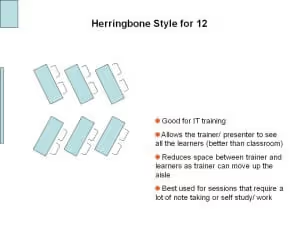
Advantages – Space effective for large numbers, All participants are at a good angle to the front, Trainer can walk down spine
Disadvantages – Several participants hidden by others, Reminiscent of school, Encourages dysfunctioning groups, Relatively poor contact
BoardRoom – Training or Meeting Room Layout Style

Advantages – Good for small groups, can see/ interact with others, can share resources, creates equality
Disadvantages – Difficult for some to ‘see the front’,
Circle or ’round’ – Training or Meeting Room Layout Style

Advantages – Creates Equality, Good for small groups, can see/ interact with others, can share resources
Disadvantages – Formal, participants having to look at an angle
Cabaret, Gala or Bistro – Training or Meeting Room Layout Style


Advantages – Good for larger numbers, Good for group work, Encourages mixing, Trainer or presenter can circulate
Disadvantages – Some participants will have poor visibility, May encourage lack of attention, Needs multimedia (PA & mic for best effect)
Training or Meeting Room Layout Summary
When you run your meeting or training event, it’s not just room layout that is important, it’s about matching the room layout with the trainers style, the material to be covered and the required outcomes. The room shape and design can make or break an event.
Computer training layouts

Depending on the nature of the room many of the layouts above can be used for PC training. The key thing is having space for people to move. Sitting on one place for extended periods of time is not conducive to learning. We need to “get physical” and move around. Given a choice I prefer boardroom layout.
When setting up rooms for computer training be very aware of light reflections from windows and the ambient temperature and airflow in the room. A room with 8-10 people and computers can get very hot and very stuffy very quickly.
Book WorkSocial’s Specially Designed Training Rooms
Credit:
Post Author: Mike Morrison
Website: https://rapidbi.com/

Anyone can seem cool. Wear the right clothes, drive the right cars, take the right vacations, carefully craft social media updates … Seeming cool is easy. Actually being cool is anything but. I’m not cool. (I’m as average as they come.) But I do know some cool people. Here are some of the things that make them cool.
1. They’ve done awesome things I don’t know about.
Why don’t I know about the awesome things they’ve done? Because they just do them. And if I ever do find out, I’ll find out in person. From a casual conversation. Or even accidentally. But not through social media. Why? Cool people see the experience as the end result — not sharing that experience with as many people as possible.
2. They don’t think work/life balance. They just think life.
Drawing a line in the sand to create an artificial work/life boundary never works. Why? You are your business. Your business is your life, just like your life is your business — which is also true for family, friends, and interests — so there is no separation, because all those things make you who you are. Cool people find ways to include family instead of ways to exclude work. They find ways to include interests, hobbies, passions, and personal values in their professional lives. Because if you can’t, you’re not living. You’re just working.
3. They don’t take pictures of famous people.
Seeing a famous person, even at a distance, is oddly fun. Can’t explain it; it just is. But taking a picture of — or with — that person doesn’t confer any coolness on you. Nor does sharing it with your friends. Besides: Life is not the zoo. So don’t treat other people like it is.
4. They relentlessly seek new experiences.
Novelty seeking — getting bored easily and throwing yourself into new pursuits or activities — is often linked to gambling, drug abuse, attention deficit disorder, and leaping out of perfectly good airplanes without a parachute. But, as Dr. Robert Cloninger says, “Novelty seeking is one of the traits that keeps you healthy and happy and fosters personality growth as you age … if you combine adventurousness and curiosity with persistence and a sense that it’s not all about you, then you get the creativity that benefits society as a whole.”
According to Dr. Cloninger, “To succeed, you want to be able to regulate your impulses while also having the imagination to see what the future would be like if you tried something new.”
Sounds like every cool person I know.
Embrace your inner novelty seeker. You’ll be healthier, you’ll have more friends, you’ll be generally more satisfied with life … and you’ll be a little cooler, too.
5. They do nice things, just because they can.
Richard Branson gave me half of his sandwich. Jimmie Johnson stayed late so I could interview him. Mark Cuban stopped to chat with an intern. Joe Gibbs gave every member of a production crew a signed copy of his book after we filmed an interview. Kirk Hammett hung around to meet Inc. staffers, and then gave me tickets to Metallica’s surprise Webster Hall show.
Most of us are nice, especially when we’re expected to be. Cool people are nice even when no one would expect them to be. Not because they have to. Just because they can.
6. They constantly try to prove something — to themselves.
Many people have a burning desire to prove other people wrong. There’s nothing wrong with that; it’s a great motivator. (Hi, Michael Jordan.) The coolest people are also motivated by something deeper and more personal. Their drive, commitment, and dedication springs from a desire to prove something to the most important person of all. Themselves.
7. They find happiness in the success of other people.
Every great entrepreneur answers the question, “Can you make the choice that your happiness will come from the success of others?” with a resounding “Yes!” So does every cool person I know. They enjoy personal achievements, but they really enjoy seeing other people succeed.
8. They see money not just as a reward but also as a responsibility.
The coolest wealthy people I know see money as a way to grow their business, to reward and develop employees, to give back to the community … not just as a way to make their own lives better but to improve the lives of other people, too. And they do so without calling attention to themselves — because the true reward is always in the act, not the recognition.
9. They’re entrepreneurs — whether in fact or in spirit.
Success is difficult to achieve no matter what the pursuit. That’s why we all fail sometimes. And when we do, it’s easy to decide events were outside our control. It’s easy to feel depressed and wonder, “Why don’t I ever get the opportunities other people get?” or “Why aren’t my friends more supportive?” or “Why can’t I catch a break?” In short, it’s easy to think: “Why me?”
People with an entrepreneurial mindset ask a different question: “Why not me?”
The coolest people I know don’t assume successful people possess special talents or gifts. They see successful people and think: “That’s awesome — and if she can do that, why not me?” Good question: Why not you? And, most important …
10. They don’t think they’re cool.
Social media makes it easy to do your own public relations. You can blow your own horn, bask in the glow of your insights and accomplishments … With a little time and effort, you can seem larger than life.
Cool people don’t. They know their success is based on hard work, persistence, and execution, but they also recognize that key mentors, great employees, and a huge dose of luck also play a part in their success.
That’s why they’re humble. That’s why they ask questions. That’s why they seek advice. That’s why they recognize and praise others.
They don’t focus on highlighting how far they’ve come — because they’re too busy thinking about how far they still want to go.
Credit:
Post Author: www.inc.com
Website: https://www.inc.com

Many of the negotiation techniques we teach at Black Swan Group are part of a “no” strategy. We discuss ways to make “no” work for you in a negotiation; share tips on how to get buy-in, starting with a “no” ; and offer communication techniques to help create space between “yes” and “no.”
In our everyday lives, we see “no” as a form of rejection. In most situations, “no” signifies an end rather than a beginning. So why do we go out of our way to make “no” our goal in negotiations? Below, we’ve outlined the top reasons why a “no” strategy is the ultimate secret weapon.
Saying “No” Settles The Stomach
Whether or not we acknowledge their power, emotions guide our lives. They dictate our thoughts and perceptions about the world and actively influence our behavior. We are emotional creatures by nature, and the world is an emotional minefield. Surprisingly, saying “yes” to things naturally makes people more anxious than saying “no”.
Our emotional reactions tend to manifest in a physical way, as intense sensations that are both chicken and egg to our thoughts. They surface as butterflies or knots in our stomach, as a twinge or pang in our gut, or as a tightness or pounding in our chest. In fact, negative emotions have a more immediate and lasting effect than positive ones. You can be in a relationship, be very happy, see that person everyday and be very happy and contented. You can also end a relationship and be upset for months and never even see the person. If you have every been in a relationship, ask yourself which of those emotions you felt was more powerful. On a basic level, we all try to get through our day feeling emotionally balanced and in control—and we actively avoid situations that might make us feel the opposite.
Being pushed to say “yes” before we’re ready is one of those situations that feel downright uncomfortable. In a negotiation, asking yes-oriented questions can make your counterpart feel trapped and trigger a negative domino effect. When this happens, our fight-or-flight instincts kick in, and our emotions start to override our reasoning and comprehension faculties.
Oftentimes, we need to say “no” before we’re ready to say “yes.” In new situations, saying “yes” is a concession that magnifies our sense of vulnerability. On the other hand, saying “no” is a convenient means of self-preservation. It doesn’t require any real effort or emotional investment.
When you give someone the ability to say “no” by asking no-oriented questions, you respect their autonomy and preserve their emotional safety net. By awarding them the right to veto, you keep them engaged and nurture trust while still satisfying their need to set boundaries.
“No” Is More Accurate and Informative Than “Yes”
There’s another key reason why asking, “Do you disagree?” is more effective than, “Do you agree?” To avoid conflict (and keep our tummies feeling good), it’s much easier to go along with someone than it is to rock the boat. When you ask yes-oriented questions that you already know the answer to, you give people a one-word escape route that’s difficult to pass up. To satisfy you and move on with their lives, all they need to do is tell you what you want to hear—even if they don’t genuinely agree. In this way, asking yes-oriented questions can inspire counterfeit or tepid deals that don’t hold up during implementation. When you ask someone, “Do you disagree?” you open yourself up to correction, making it possible for them to express their honest opinion without creating conflict.
Asking yes-oriented questions also limits your learning opportunities. In any negotiation, your persuasive abilities are limited to what you know. In order to build trust and influence, you must uncover “known unknowns” (things you know you don’t know going into the negotiation) and “unknown unknowns” (things you don’t know you don’t know until they are revealed). Both types of unknowns will exist in every negotiation—it’s up to you to uncover them.
As a general rule, people love to correct. Yes-oriented questions leave no room to exercise this natural impulse. By giving your counterpart the option to say “no,” you also create space for them to explain why they disagree. Creating this opportunity for explanation will help you understand their core drives and empower you to communicate more effectively
Executing a “No” Strategy
Taking a “no” approach to negotiation can involve more than just no-oriented questions.
Labels are also great tools to use if you’re genuinely unsure of something or if you’re trying to get a handle on the underlying conversation dynamic. Similar to a no-oriented question, a mislabel (when executed with the appropriate tone) invites your counterpart to correct you and expand on what they mean. Once they do so, use another label to demonstrate understanding, followed by a calibrated question to find out more. For example, “It sounds like I missed something. How do we get back on track?”
In addition to learning the right techniques, executing a “no” strategy requires a change in your negotiation mindset. Too often, salespeople and other professionals who negotiate frequently have a “yes” addiction, which flows both ways. In addition to fishing for a “yes,” you are consequently very vulnerable to the counterfeit “yes”—the “yes” that is given just to make you shut your mouth. The negotiator with the “no” strategy will never fall victim to this dynamic. Human beings love to be agreed with and told they are on the right track and wanting approval is in our bones. It’s not an easy shift to put yourself in a place where you are seeking correction or additional thought. However, people don’t come to the negotiation table to tell you how great you are, also a human nature. Which human nature trait do you plan on using to your advantage? To truly implement a “no” strategy, it’s important to channel your emotional intelligence to recognize and correct these habits in your own communication.
For more expert negotiation tips and techniques to use at work, download our latest e-book below.
Go to our Eventbrite page for Tickets
Credit:
Post Author: Brandon Voss
Website: https://blog.blackswanltd.com

New Age Program By WorkSocial Connecting Corporate Trainers and Enterprises
WorkSocial, a minority- and woman-owned coworking and corporate education space in Jersey City, New Jersey, announced new partnerships with globally recognized corporate trainers at their Jersey City location.
As a leader in the sharing / gig economy, WorkSocial continues to disrupt the corporate office landscape by providing services to companies that not only occupy its offices but also its community. In a recent unveiling WorkSocial’s leadership announced a series of training and L&D educational content.
This initiative is a part of the community enrichment effort which allows small companies to train employees in batches, rather than taking an entire team off the clock at one time. In a statement to the press, Natasha Mohan, founder and CEO of WorkSocial said “small businesses and entrepreneurs are the life blood of America. Our country is great and filled with opportunities. My mission in the education space is to bring world class content to the people of New Jersey and specifically Jersey City.”
WorkSocial was started by Natasha’s Mohan who is a residential and commercial real estate veteran.
“When I talk to trainers and companies about my vision of bringing world class corporate education to small businesses the size of the opportunity and impact is not understood. Our research supports that this market is valued at $20 Billion. By applying the sharing model to the platform we have dis-intermediated the buying pattern and exponentially grown the opportunity ten fold.” Its a no brainier. “WorkSocial is the Uber for office space and corporate education, only without the drama and crazy commissions.”
WorkSocial’s corporate training team identifies the best trainers in America. These trainers typically offer their services at premium prices making them accessible only to large companies who have a multi-million dollar training budgets and the ability to take a service line off the clock for two or three days. “A small business cannot afford to pay large dollars and send teams to train. This can put it at a competitive disadvantage. I wanted to change this and did. Our sharing approach not only gives the same opportunity to a small business that has a small team it also makes it affordable. We find ways to subsidize costs”
Confirmed speakers and training in 2019 include the following (https://worksocial.works/events):
- Chris Voss – Negotiation
- Marshal Goldsmith – Stakeholder Centered Coaching
- Thomson Reuters – ONESOURCE Workpapers
- SAP – S4 Hana for Finance (Global Knowledge)
- Alteryx – Certification Class (Renato Baruti author and speaker)
- RPA – Robotics Process Automation using UI Path
- Exponential Organizations – by Peter Diamandis
- SQL BI – Business Intelligence using Microsoft Power BI
The WorkSocial Approach: Abundance in a Scarce Economy
After a trainer schedules their event, WorkSocial issues a major announcement and press release across several marketing platforms, and rolls out an email campaign inviting its members to attend the training event. Their trained sales team also deploys a direct sales campaign, while event planners negotiate discounted hotel rooms for attendees and organize networking dinners. Trainers typically schedule multiple events to maximize their time and investment in Jersey City. As an unexpected bonus, WorkSocial pays for the trainer’s hotel room and basic expenses.
WorkSocial’s corporate training room rental is almost sold-out to capacity for 2019.
Our focus is to bring in the best education in sales training, technology, leadership, risk management, data management, human resources, and entrepreneurship.
Availability for 2020 is also limited, with a fantastic trainer lineup that includes including:
- Greg Wells – Augmenting Humanity Mindset Training
- Blue Prism Robotics
- R and Python for Business
- Find your Why by Simon Sinek
- Sales Training based on a Tony Robbins NLP technique
For more information, contact:
Natasha Mohan
[email protected]
(201) 210-8255
Please try different keywords.