

The Work-life Insight


1. Create a Daily Gratitude Practice: Every morning during my 10-minute meditation, I focus on gratitude and how I can be 30% more joyful throughout the day. In the evening, when I’m going to sleep, before I drift off, I recall the 3 things I am most grateful for from that day.
2. Let the Most Important People in Your Life Know How Much You Value Them: Who are the people you’re most grateful for? Tell them how much you appreciate them! After all, “life is who you go through life with.”
3. Double-down on Your Passion: Your personal passion is your highest calling… the challenge you’re in love with, and the vision you have for yourself. It’s also the emotional fuel you need to keep you going in the face of inevitable hardships.
4. Develop Your Massive Transformative Purpose (MTP): An MTP is a clear, succinct statement that guides you, empowers you, and helps you decide what to do—as well as what not to do. My MTP is… “To inspire and guide entrepreneurs to create a hopeful, compelling and abundant future for humanity.”
5. Resolve to No Longer Resent Missed Opportunities: In a world of ever-increasing abundance, the future holds many more exciting, fulfilling, and profitable opportunities for you to pursue. Don’t regret the past. Live for your abundant future.
6. Go on a “Media-Diet”: Stop watching CNN, FOX, TikTok… Stop watching the dystopian news and wasting time on social media. This one step can boost your mood 10X.
7. Consume Optimistic / Future-Positive Content: There are a TON of incredible breakthroughs helping to create a world of abundance happening all the time. But you would never know this from the constant stream of negativity from most news outlets. Consider finding media sources that deliver you positive and optimistic insights. (I use the Futureloop News Feed every day. You can check it out here. It’s free and fun!)
8. Embrace Data-Driven Experimentation: Exponential entrepreneurs use rapid iteration and data-driven experimentation to foster creative solutions to previously unsolvable problems. What experiments can you run in 2022 to improve your business?
9. Digitize Everything You Can: Once you digitize a product or service, it jumps on the 6 Ds exponential roadmap and begins a journey towards becoming dematerialized, demonetized, and democratized. What parts of your business can you successfully digitize?
10. Identify and Pursue a Moonshot: Where can you go 10X bigger or better in your business while your competitors are pursuing incremental change? A Moonshot can fuel your life and make every day worth living to the fullest.


1. Prioritize Sleep: Don’t underestimate the importance and positive impact of sleep. Make a goal of 8 hours of sleep each night. Get to sleep early, wake up early and get a jump on the day!
2. Exercise & Build Muscle: Muscle mass is one of the most important predictors of longevity and speedy recoveries from injuries. Even a small amount of weekly resistance or weight training can stimulate growth hormones and increase muscle mass.
3. 10,000 Steps Each Day: You’re never too busy to get moving. Resolve to take at least 1 hour of Zoom or phone calls while walking. I do it every day. It’s easy and fun (well, especially in Santa Monica).
4. Minimize Sugar: It’s simple… Sugar = poison. It causes inflammation, cardiovascular disease, and fuels cancer. Go on a 10-day sugar fast and cut it out of your diet completely for several days. It’s possible, especially if you do it alongside friends.
5. Upgrade Your Community: The people you spend time with shape who you are, what you think and what you do. Hang out with young or young-minded individuals who care about their health! Spend time with friends who are optimistic and those who actively pursue longevity.
6. Do an Annual “Full-body Health Upload”: Most of us have *no idea* what is really going on in our body. Every year, I visit either Fountain Life of Human Longevity’s Health Nucleus to do a full body MRI, an AI-driven CT, Genome, microbiome, and much more. A key to longevity is proper screening and preventative medicine.
7. Drink 2-3 Liters of Water Every Day: If there’s a magic fuel source for the human body, it’s water.
8. Eat a Whole-plant-based Diet: I avoid red meat (which can result in cancer, heart disease, and diabetes), and focus on a Mediterranean plant-based diet and fish rich in vitamins, minerals, and antioxidants.
9. Intermittent Fasting for 12+ Hours: I do my best to fast between 7pm and 12 noon the next day, providing me a 17-hour fast. It gives me extraordinary energy during the day and helps me remain fit. Give it a try! (Remember: drink lots of water!)
10. Read Longevity Enabling Content: Be the CEO of your own health and stay up to date on the latest advancements in medicine. Consider reading my AI-enabled longevity newsletter (www.longevityinsider.org). It’s free and will give you a daily dose of insight and optimism.
I hope you’ll challenge yourself to adopt some (or all!) of these.

Tech entrepreneur Chris Herd gained a devoted following during the pandemic by advocating for alternatives to working in an office. Yet, The New Yorker notes he’s also against the idea of remote-only work arrangements. Herd says he follows an office-free “remote-first” structure, which calls for relevant teams to meet on occasion at locations,like private offices for rent that fit the work being done. Herd also says a remote-first strategy broadens the talent pool globally, far beyond an office building’s general radius.
FOR IMMEDIATE RELEASE
Jersey City, NJ, December 28, 2021— Finding an ideal workspace is much easier said than done. There can be distractions all around that affect productivity. WorkSocial is here to solve that problem!
WorkSocial can provide you with the best coworking space Jersey City has to offer! The New Jersey based company provides a wide variety of working environments suited to your specific needs.
Whether you are looking for a small private office or a conference room for rent in Jersey City, WorkSocial has you covered!
WorkSocial can provide you with an office for whatever time you need. Whether you are looking for a short gig, or a long-term stay, WorkSocial has something for everyone!
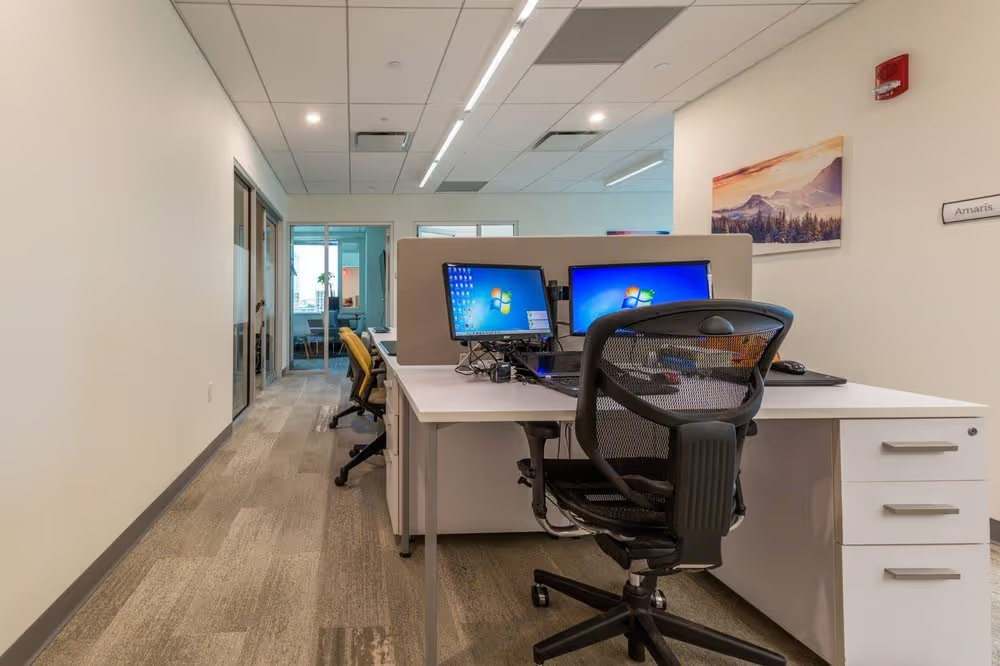
All the offices are already furnished and come with a tremendous amount of amenities.
Every location comes with a staffed reception area along with complimentary drinks and snacks! There is also free high-speed wifi and printing services at WorkSocial locations.
In addition, you can enjoy business lounges, conference rooms, and breakout rooms that are all included with your office space! These locations come with mail services and even an on site public notary!
Technology can be a very important aspect of any business. To accommodate for all your technological needs, WorkSocial provides state-of-the-art presentation equipment along with IT services to ensure your equipment functions properly.
“I was seriously blown away at the amenities. WorkSocial really does go a step above and beyond,” said one satisfied customer.
In addition to providing the highest quality office spaces for you and your team, WorkSocial offers these outstanding work environments at competitive rates so that you don’t have to break the bank to find a place to work.
Rates vary from location to location and are priced at a daily price, so there are no long-term obligations with WorkSocial.
“We pride ourselves on our ability to provide a low stress, high-quality environment for our clients,” said the CEO of WorkSocial.For more information on WorkSocial, you can check out their website. The website is easy to navigate and user-friendly.
You can view the many available work spaces along with an in-depth description of each site with pictures to give you an accurate idea as to what each office is like.
Also available on their website is a helpful blog that is filled with helpful information for anything business-related.
WorkSocial has the best office space for rent Jersey City has to offer, check them out today!
About WorkSocial: Our office space in New Jersey comes with a wide selection of collaboration spaces. Your teams are returning back to work. Our teams are charting the course in developing a safe environment to work and collaborate. We take are taking a comprehensive approach to make sure your team creates an office experience your people will love.
Contact Information:
Natasha Mohan
WorkSocial, 111 Town Square, Suite 1203, Jersey City, New Jersey
Rent Coworking Space Jersey City

Over the past year, WorkSocial Jersey City experienced a 43% revenue growth and is anticipating to see even more growth in 2022 as demand for flexible offices rises.
WorkSocial saw its revenue grow by 43% in 2021, and the company expects to see continued growth in the new year as demand for coworking spaces rises.
In order to meet this demand, WorkSocial's CEO Natasha Mohan announced that the firm plans to expand its portfolio through strategic alliances with other coworking spaces that are owned and managed by female and minority-run operators.
Corporates want to adopt a hybrid model in their real estate strategy as they come out of the pandemic. [Corporates] want multiple products and multiple solutions for how they want to operate. We are seeing now more than ever that the social contract between employer and employee is being redefined. Employees are looking for employers and employers are looking for partners to jointly serve customers.Currently, WorkSocial has 18 locations across 15 cities, equating to about 1800 seats. Occupancy across Workocial locations has also reached surpassed 90%, which kept its portfolio profitable during throughout the pandemic
Today companies of all sizes, be it a 100-year-old company or a startup, are looking at flexible space as the way to move forward,” said Mohan.WorkSocial continues to create an impact in the communities its serves. WorkSocial consistently donates cash and in-kind services to local charities.
"Our primary focus is ending world hunger." We are too small to end world hunger so we make sure we consistently feed people.
About WorkSocial: WorkSocial offers designed shared offices and coworking spaces in Jersey City in a most desirable area to fit the professional needs of today’s workforce in an environment that supports business growth, creative collaboration, and overall professional success, at every stage of your career.
Contact Information:
Name: Natasha Mohan
Address: 111 Town Square, Suite 1203
Phone Number: 201-210-8255

Whether you're looking to start your own business or grow your brand to new heights, WorkSocial is the place to be! WorkSocial is Jersey City's premier coworking space, offering shared office solutions to fit your business needs and support your career goals in a modern, open environment that allows you to work alongside others who share your ambition and desire to succeed. Today, WorkSocial is proud to welcome Global Philanthropies to their ever-growing professional community. Contact WorkSocial to find your ideal coworking space today!
Jersey City, NJ, December 27, 2021--- Today's professional workforce recognizes the value of open, inspiring office spaces, social collaboration, and the benefits of being part of an energizing working community that supports the collective success of everyone involved. Enter WorkSocial, an all-in-one solution that answers the call of aspiring entrepreneurs, established business owners, busy professionals, and work-from-home freelancers who are looking for a place to take their career goals to the next level.
WorkSocial has become home to some of Jersey City's most talked-about success stories. Their shared offices attract some of the most trusted brands in the business world, along with the area's top buzz-worthy startups and entrepreneurs.
Today, WorkSocial is honored to announce one of their newest partners, Global Philanthropies. Global Philanthropies has grown to become an established leader in world-class philanthropy, sharing hope and resources with people in need, and connecting people with purpose, all across the globe. It's companies such as Global Philanthropies that keep WorkSocial going strong, committed to helping Jersey City businesses be the best that they can be.
At WorkSocial, you'll find people at every stage of the professional spectrum, working alongside one another in a variety of fresh, innovative coworking spaces designed to meet the unique needs of a diverse group of professionals across every industry. WorkSocial has the ideal office space for rent that meets every business and budget, from established enterprises to brand new startups. WorkSocial's shared working spaces have exactly what you're looking for to build your business or help it grow.
You can collaborate in common areas, reserve a conference room for rent, or sneak away into one of their many meeting rooms anytime. WorkSocial eliminates the need to break the bank on renting office space that doesn't live up to your expectations despite its' expensive price tag. Now, anyone can afford an attractive, professional workspace, equipped with ample space, modern furnishings, eco-friendly practices, roomy restrooms, clean breakrooms, and essential office equipment to ensure you have everything you need to achieve your personal career goals.
If you're ready for a fresh, exciting coworking space that supports your professional dreams, put WorkSocial to work for you. Contact WorkSocial today to find the perfect shared office environment to fit your business needs today!
About WorkSocial: WorkSocial offers shared offices and coworking spaces designed in Jersey City's most desirable areas to fit the professional needs of today's workforce in an environment that supports business growth, creative collaboration, and overall professional success, at every stage of your career.
Contact Information:
Name: Natasha Mohan
Address: 111 Town Square, Suite 1203
Phone Number: 201-210-8255
“Interactions beyond work to provide help and encouragement are key to building trust. We love and cherish long-term relationships with our employees.”
Co-working spaces today need no introduction. Most people inevitably know at least one person who works in a shared workspace. Simply put, co-working spaces are shared workspaces that house freelancers, startups, and corporations alike, in a common space. Members do not have to deal with the burden of expensive and long-term office rental agreements, and commercial property owners get more out of spaces that are lying idle by renting out to co-working players.
In light of the foregoing, we’re thrilled to present WorkSocial — a leader in the co-working space industry. The company supplies its clients with comfortable state-of-the-art conference rooms, well-stocked kitchens, and most importantly the belief that their business matters. Its mission is to become more than a run-of-the-mill shared office rental space provider; a movement that is driven by the fundamental spirit of entrepreneurship.
WorkSocial was incorporated in 2015 and is headquartered in Jersey City, NJ.
Natasha Mohan, WorkSocial Founder, and CEO, spoke exclusively to The Silicon Review. Below is an excerpt.
Q. What are the different amenities that are available in your co-working space for businesses to remain operational?
We are an all-inclusive one-stop co-working solution for businesses. We strive to be a full-service provider for our clients by providing amenities such as phone booths, stand-up desks, high-speed internet, security, onsite cleaning staff, in addition to spacious AV-capable conference rooms. We have a dedicated full-service team in place to assist our clients to solve any business, IT, or space issues that may arise during the day. Importantly, we have acquired the DGE clearance to be able to serve gaming and high-tech companies.
Besides this, we offer in-house weekday lunches to our clients keeping in view COVID-19 restrictions.
Q. Being around other people can be a great motivation to stay productive during the workday, but it can also mean being surrounded by distractions that will limit productivity. How can we overcome this?
The science behind our co-working space is to increase productivity. The ergonomics, aesthetics, and feng shui of a space enhance productivity and joy. With that in mind, the interior lighting has been carefully selected to meet the needs of each office space. And to respect our clients’ privacy and need for silence, we have installed white noise machines, which also reduce echoes. The color scheme was thoughtfully selected to promote happiness in the workspace.
Additionally, to avoid distractions, the private office is completely enclosed with white walls compared to other glass wall co-working spaces. The atmosphere we created is more toward the enterprise coworking environment, with the intention that our clients are encouraged to be mindful of others sharing the space.
Q. Lack of customization and branding is seen as a potential drawback for co-working spaces. Can we expect a solution to this? And what are the anticipated trends in the co-working spaces due to Covid?
Our branding is strategically placed throughout the building in many forms. For example, on the eco-friendly mugs our clients use—to remind them that we are increasing our green footprint. We also have branded masks to make sure they are doing their part to keep all of us safe. The anticipated trends in co-working spaces during the pandemic have increased our cleaning protocol. We provide clients with day use of the offices and have arranged for medical staff to periodically stop by to conduct onsite voluntary COVID testing. We’re also trying to limit our clients’ need to leave the building during the day by providing food and snack options onsite. That said, healthy, happy, and productive is how we want our clients to feel in our space.
Q. ‘When people are having fun, they work together better and they produce better work.’ How do you interpret this saying?
As human beings, we are social animals, we need to be surrounded by others to find inspiration and daily motivations. In other words, it’s ideal to be around motivated people than to sit in isolation and work. With people being forced into isolation during this pandemic, the incidence of depression has gone up. We need to combat that by continuing to meet and work with people safely, considering sound mental health is very important to us.
Q. Growing the company based on employees’ passions must be a priority. Do you ask your employees what they are interested in doing and how they would like to see their career unfold?
As of now, we are all multi-tasking since our team is pretty small. They are encouraged to express themselves and how they can contribute to the organization. We are a young company so we grow as our employees grow. There is a shared goal and interest but also high energy buzzing to keep us on our toes. Yes, on occasions, we do talk about where they want to be placed in the company as we grow. I care about my team and love their work. If there are tasks that don’t resonate with them, we figure out a solution to ensure every goal is reached.
Q. Trust is a difficult attribute to measure and a delicate dynamic to maintain. How do you maintain this with your employees?
We provide them with all the resources and support to help them make the best decision for the task they are given. It is about giving them autonomy and feeling as vested in the company as I do. I trust them to make the right decision, but if they are truly stuck, I make sure I am there to help them through the process. We’re not only co-workers but also a family. Interactions beyond work to provide help and encouragement are key to building trust. We love and cherish long-term relationships with our employees.
Q. What does the future hold for WorkSocial and its employees? Are exciting things on the way?
We, as a company, are growing every year, whether it is expanding our workspace, cleaning up processes, or hiring new employees. We have many plans for expansion in the future, possibly in different states.Natasha Mohan, a Trusted Leader: In Her Own Words
I am Natasha Mohan, the founder of WorkSocial. I, like many women entrepreneurs, multitask as I jump from being mom and wife to businesswoman, and mentor all in a day’s work. It’s not easy but I enjoy the challenges that life brings me. Who I am as a person shapes my leadership. My early life experience in the hospitality industry adds to my customer service model. I have spent the last 20 years in the real estate industry climbing the ranks and making a name for myself. Working in the real estate industry was a natural progression to wanting to open my own co-working space. Over the years, I have seen office spaces not fulfilling clients’ expectations and how it impacted them. That being the sole reason, I wanted to offer an ideal co-working space for clients where they can grow their businesses and be inspired to fulfill their dreams.
I find my work-life balance by taking time to be with my teenage kids, husband, and puppy. Family is very important and they have supported all my aspirations and dreams.
“We are an all-inclusive one-stop co-working solution for businesses.”
Credit:
The Silicon Review
Website: https://bit.ly/3JgAAJv/;


Periods of uncertainty and upheaval often have far-reaching effects on society. They can even lead to people resigning from their jobs.
During the pandemic, the world changed. There were shutdowns, quarantines, and restricted access to goods, services and jobs. Many businesses in the retail, hospitality, food services and travel sectors furloughed and laid off employees. And across multiple sectors, many employees worked from home for extended periods of time -- many for the first time in their careers.
With such large-scale disruption in the economy and the lives of hundreds of millions of people, many people have a renewed focus on what matters most to them. That period of introspection and reflection has led employees to rethink their jobs and their career paths.
Most large employers think that their employees are leaving for better jobs. In their view better equates to higher-paying jobs. Yes, the jobs are higher-paying, not just in dollars or cents. These jobs align better to peoples post-pandemic lives.
Almost EVERYONE has had to redefine their business and purpose.
WHY NOT THE BUSINESS?
But for all the negatives of the “big quit,” I see it as offering an enormous opportunity for business leaders to reassess what already makes them (or stands to make them) a company that current employees want to stay with and prospective employees want to join. Whether seeking a new job or thinking about leaving a current one, many people are looking for well-tailored benefits that promote emotional, physical, and financial wellness.
In that sense, the Great Resignation frames this moment as a crisis. While Klotz may not have consciously linked these past eras, the name likens this to a period of withdrawal. It also centers the immediate consequences for employment status and the job market. But focusing on resignation as a crisis flattens the dramatic change for American values, which could have far-reaching consequences outside of the workplace. For Americans who live with few social safety nets or identify by their work, quitting is a touchy business, often shrouded in a mix of secrecy, shame, and emotional labor. Under the banner of the Great Resignation, individuals are nudged to confront a constellation of questions around the immediate act of leaving a job: Should I do it? Can I afford to? What would I do afterwards? This reflection has real value; people may more actively take stock of their work situation, think through the steps it would take to change, and get the gumption to act amid a broader cultural moment focused on resigning. But in their own words, many people who have been part of this movement explain their choices as a result of reevaluating their lives and where they derive meaning. In this case, a resignation crisis feels like a limiting metaphor when leaving a job may just be collateral to a deeper realignment in American work life.
The Great Resignation indicates mass quitting is a crisis and concentrates on the immediate consequences for employment status and the job market. But focusing on resignation as a crisis lessens the dramatic change in American values.
Americans don’t have social safety nets or identify by their work. Quitting is a touchy business, often shrouded in a mix of secrecy, shame, and emotions. The Great Resignation is confronting people with questions that can have long-term effects on their wellbeing. Questions like should I quit, can I afford it, and what will I do spur individuals to think hard about leaving. With that being said, self-reflection has value.
Many people who are already part of the ‘Big Quit’ movement (meaning they have already resigned) explain their choices due to re-evaluating their lives. So perhaps we’re not experiencing a Great Resignation, and instead, we’re participating in a great work change that can shape the future of the workplace.Part of the challenge is that businesses don’t have a game plan to follow. Companies have never encountered so few potential job candidates in recent history. Many companies arerapidly shifting office culture and attempting to navigate the new normal of people expecting flexibility at the workplace. While there may still be debates over remote work, people want the option to stay home.
Regardless of the Covid-19 pandemic, no business can operate without workers. Companies should be focusing on embracing the movement and listening to the needs of employees rather than ignoring them. Workers are not asking for much here. Check out the following ways you can help combat the Great Resignation at your workplace.
People’s needs, priorities, and expectations have changed. Understand what your employees require to feel safe, supported, and secure at work.
Invest in taking care of your employees and their families. Mental health resources and help with childcare can go a long way.
Address burnout and boost workplace wellbeing.Prioritize culture and connection. Leave work aside once in a while to connect and build relationships with your people.

Jersey City, N.J. (December 21, 2021) – As the demand for shared office spaces increases, one local coworking space, WorkSocial, is expanding its Jersey City office space footprint by 6,000 square feet to accommodate the growing number of entrepreneurs, small businesses, and consultants seeking the company’s offerings.
The expansion work at 111 Town Square Place in Jersey City begins in February and will be open to clients in April 2022.
Since 2016, WorkSocial has been providing coworking spaces and private offices for rent that provides small businesses and individuals a refreshing alternative to home-based work or meeting in public places like coffee shops. Members benefit from a dedicated on-site service team, upbeat culture, state-of-the-art technology, access to private offices and group conference rooms and business services like reception, mailing services, WIFI, and more.
The expansion will include additional offices, six new meeting spaces, and five phone “booths” where clients can take private calls. “This is such an exciting endeavor,” explains Natasha Mohan, CEO. “It was designed by an all-female minority team and inspired by offices at Google and Facebook.”
The coworking trend was already growing rapidly before 2020 but COVID-19 changed how people worked, particularly in the business-dense Tri-State area. When it was clear many companies were asking their employees to work from home, WorkSocial sprung into action, making sure their locations in both Jersey City and New York City were open and adhering to strict social distancing and sanitizing protocols. The effort paid off.
“Working from home can be isolating,” explains Natasha Mohan, CEO of WorkSocial. “Our clients wanted to be able to go somewhere where they could access everything they needed but without worrying about safety. That trend continues now, with the rollercoaster we are seeing with the COVID-19 variants.”
COVID-19 also brought a significant increase in people leaving – or losing – their jobs and pursuing their own business dreams. In fact, according to Census Bureau’s data, nearly 1.4 million applications were filed to form new businesses through September of 2021. Comparatively, 2020 had around 1 million and 2019 had 987,000 during the same time periods.
“Our space and services are ideal for new start-ups that are learning what resources they need and how to manage them,” says Mohan. “We provide that support so they can concentrate on their business and not have to worry about office space, technology or support services. We provide a professional mailing address as well so they aren’t sending mail to their apartment, for example,” she adds.
Importantly, WorkSocial allows small businesses to offer their employees a pleasant and highly functional work environment without the burden of overhead.
Mohan says the new space they are building is already 60% reserved. “It gives us great joy to be a resource to the people and teams who work at our facility. There is so much creativity and energy; it’s exciting to come to work here every day.”Since 2015, WorkSocial has been offering highly functional, pleasant coworking spaces in New Jersey and New York City to teams, entrepreneurs, small businesses, and individuals.
Our mission is to provide a workspace that supports small business endeavors, community outreach, mentoring and entrepreneurial needs while promoting a well and happy lifestyle. For more information or reservations, please visit:


Think about a moment of self-care. Chances are, it didn’t happen at your office.
Self-care has habitually been saved for outside work hours. So it probably won’t come as a shock that conventional working spaces aren’t necessarily mental health-friendly.
But since the Covid-19 pandemic hit, traditional offices appear to have been radically modified. Stationary, inflexible cubicles are being reimagined into open spaces where workers can freely exchange ideas, mobile tables replace individual desks, open kitchens are fully stocked, and assigned seating is out the door.
Coworking spaces are changing the future of how we work and championing a new era of self-care in corporate America. Here’s how.
The Post-Pandemic Workplace
Currently, the number of people occupying coworking spaces in the United States is close to a million. While the future of work can still seem a little uncertain, coworking is a positive change brought into the workplace due to the pandemic. Blended workplaces are predicted to be the new ‘norm.’ Some people will work from home while others work from the office on specific days.
Coworking spaces are designed to accommodate people’s unique behavioral habits. Physical offices must now adjust to a more forward-thinking, creative working environment where workers have the tools they need but still feel a sense of flexibility and autonomy. At the same time, more companies are seeing that the social aspect of the working environment is one of the most critical parts of the physical workplace.
The relaxed atmosphere is usually influenced by the fact that people who work in coworking spaces could be from various companies, professions, etc. This usually means there’s less of a sense of competition.
Leaving the One-Size-Fits-All Mentality
Companies of all sizes and sorts are starting to ask their employees how, when, and where they want to work. Flexibility at work in regards to workspace preference and scheduling is vital for well-being.
Allowing employees to have more say in their own workplace experience is a slightly newer approach to the individualized, task-oriented workforce that’s taken over for the past 70 years. Additionally, corporate America is an increasingly competitive terrain for recruiting and retaining talented workers. Coworking spaces that cater to self-care is another way for companies to rise in the “war for talent.”
The Benefits of Coworking Spaces for Mental Health
With the onslaught of coworking spaces also comes a significant focus on wellness and well-being. From lush outdoor areas with tables and chairs for meetings to large indoor spaces that resemble a mini-city inside a building, coworking spaces offer some long-overdue mental health benefits in the workplace.
The most productive coworking spaces offer an atmosphere that helps establish a healthy balance between business and private life. With the challenges of everyday life, there’s sometimes a need for quick breaks in a relaxing environment. These spaces are particularly beneficial for individuals who do not have great self-care habits. Encouraging self-care in the workplace often leads to better practices outside of the job.

The Self-Care Crisis in Corporate America
It’s no secret that Covid-19 brought a slew of anxiety, stress, and other mental health issues. From the stay-at-home orders, sudden change in routines, and the overwhelming sense of worry, the impact on mental well-being is drastic for some.
Coworking spaces give employees better tools to foster good self-care habits. For one thing, most coworking spaces offer a stimulating atmosphere through exceptional room designs, colors, and plenty of natural light. These uniquely designed spaces also allow employees more flexibility. Workers often have access to different working stations depending on what they need at that moment. For example, they can work solo in a quiet private area, host a meeting in a designated room, or relax, eat, and socialize in the open lounges. Accommodating workers’ individual needs throughout the day allows them to work when they feel most motivated.
Fresh air, daylight, and personal choices can go a long way. Once companies ensure workers have everything they need - including space, office supplies, flexibility, and good self-care practices, they can start to focus their energy on doing their jobs, as the rest is provided to them.
While we can’t say yet if flexible, fluid coworking spaces are short-term or permanent, we can say the office environment is continually evolving. Coworking spaces have the potential to be part of the future of work. Why? Because physical working environments should focus more on our mental well-being.
Please try different keywords.